Why Does Cryptocurrency Have Value? Understanding Digital Assets
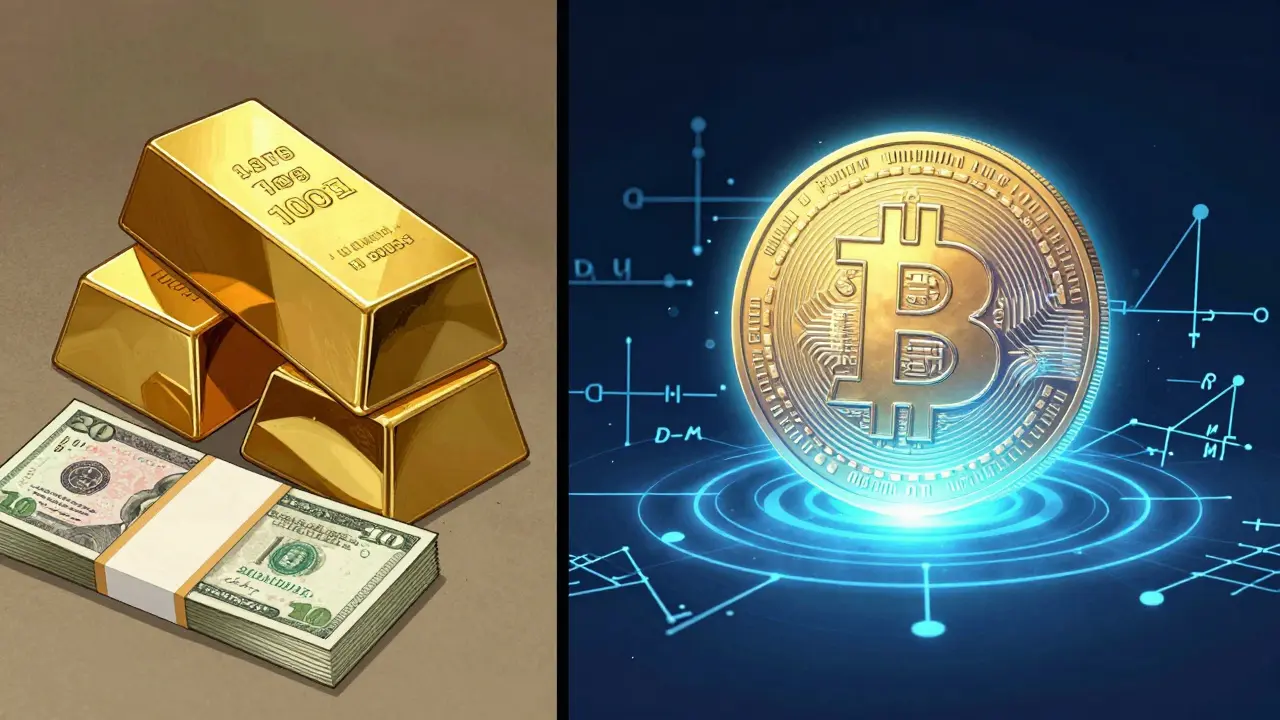
Most people look at a digital coin and ask the same question: how can something that doesn't exist physically be worth thousands of dollars? Unlike a gold bar you can hold or a house you can live in, cryptocurrency value isn't tied to a physical object. It's not like the US dollar or the euro, which are backed by governments and central banks. Instead, the value of a digital asset comes from a mix of math, psychology, and a global agreement that these tokens are actually useful.
| Feature | Fiat Currency (USD, EUR) | Cryptocurrency (BTC, ETH) |
|---|---|---|
| Backing | Government authority & laws | Network consensus & code |
| Supply | Controlled by Central Banks | Fixed by algorithms (mostly) |
| Security | Institutional insurance | Cryptographic hashing |
| Access | Bank accounts & IDs | Internet connection & Wallet |
The Power of Digital Scarcity
One of the biggest reasons a coin has value is simple economics: supply and demand. In the traditional world, if a government needs more money, they can just print more. This often leads to inflation, where your money buys fewer groceries than it did last year. Cryptocurrencies handle this differently through Tokenomics is the study of the supply, demand, and distribution of a cryptocurrency .
Take Bitcoin is the first decentralized cryptocurrency that uses a proof-of-work system to secure its network as an example. Its code dictates that there will only ever be 21 million coins. This creates a hard cap. When you combine a limited supply with a growing number of people who want to own it, the price naturally goes up. This is why many investors call it "digital gold." Just as gold is valuable because it's hard to mine from the earth, Bitcoin is valuable because it's computationally expensive to produce and strictly limited in quantity.
The Engine Under the Hood: Blockchain
Value isn't just about scarcity; it's about what the asset actually *does*. The real magic happens at the architectural level. Blockchain is a distributed ledger technology that records transactions across many computers so the record cannot be altered retroactively . This technology removes the "middleman."
Think about sending money to a relative in another country. Usually, you deal with banks, exchange rates, and high fees, and it takes days to clear. With a blockchain, you send the value peer-to-peer. It's fast, the cost is often just a few dollars regardless of the amount sent, and it's open 24/7. The value here is efficiency. You are paying for a system that is transparent, immutable, and doesn't require you to trust a bank manager to move your own money.
Utility and the "World Computer" Concept
Not all cryptocurrencies are just stores of value like Bitcoin. Some function more like software platforms. Ethereum is a decentralized computing platform that enables the creation of smart contracts and decentralized applications changed the game by introducing Smart Contracts are self-executing contracts with the terms of the agreement directly written into lines of code .
If Bitcoin is digital gold, Ethereum is more like digital oil-it powers an entire ecosystem. Because of smart contracts, developers can build DeFi is Decentralized Finance, an umbrella term for financial services built on blockchain that remove intermediaries applications. Imagine a loan where the collateral is automatically released by code once a condition is met, without needing a lawyer or a bank to verify it. The value of the underlying token (Ether) increases as more people use these applications, because the token is required to pay for the computing power (gas) needed to run the network.
The Role of Network Effects and Community
Have you ever wondered why you use a specific social media app even if a better one exists? It's because everyone else is already there. This is called the Network Effect. The same logic applies to digital currencies. A currency is only useful if other people accept it.
When a large community of developers, investors, and companies agree that a token has value, it creates a feedback loop. As more people adopt the technology, liquidity increases, which reduces the risk for new users, which in turn attracts more adoption. If a project has an active development team and a clear use case-like reducing the cost of global shipping or securing digital identity-the community's trust transforms into market value.
Speculation vs. Fundamental Value
We can't talk about value without mentioning the "hype." A lot of the price action in the crypto market is driven by speculation. People buy tokens not because they use the technology, but because they hope someone else will pay more for it tomorrow. This is where volatility comes from.
To tell the difference between a bubble and real value, experts use two main methods:
- Fundamental Analysis: Looking at the actual project. Who is the team? What problem are they solving? How many active users do they have?
- Technical Analysis: Studying price charts and trading volume to guess where the market sentiment is heading.
While speculation drives short-term spikes, long-term value is built on utility. A coin with no real-world application will eventually crash when the hype dies down, regardless of how many people were "bullish" on it during the peak.
Institutional Adoption and the Future
The narrative is shifting from "internet money for rebels" to a legitimate asset class. When major financial institutions create Exchange-Traded Funds are investment funds traded on stock exchanges that hold assets like stocks, commodities, or cryptocurrencies (ETFs) for Bitcoin, they are essentially validating its value for the mainstream public. Corporate treasuries are now adding digital assets to their balance sheets to hedge against the inflation of traditional currencies.
As we move toward a more digital economy, the demand for programmable money grows. The ability to send a payment that only unlocks when a digital product is delivered, or to fractionalize ownership of a real estate property into thousands of tiny tokens, provides a level of flexibility that traditional bank accounts simply cannot match. The value is shifting from the issuer of the money to the utility of the money.
If a government bans cryptocurrency, does it lose all value?
Not necessarily. Because blockchains are decentralized, they don't exist in one country. If one nation bans trading, the network continues to run on thousands of other computers globally. While a ban might lower the price due to reduced demand in that specific region, the underlying utility and scarcity of the asset remain unchanged.
Is cryptocurrency just a Ponzi scheme?
While there are many scams in the crypto space, the technology itself is not a Ponzi scheme. A Ponzi scheme relies on new investors paying off old ones with no actual product. Legitimate cryptocurrencies provide a service (like a global payment network or a platform for smart contracts) and have a transparent, coded supply limit that doesn't rely on recruiting new members to function.
Why isn't it just called "digital money"?
Most of the money in your bank account is already digital-it's just numbers on a screen. The difference is that "digital money" is still centralized; the bank controls it. "Cryptocurrency" specifically refers to the use of cryptography to secure the network and remove the need for a central authority, making it decentralized.
What happens if the power goes out globally?
If there is a total, permanent global power failure, all digital assets (including your bank account balance) would be inaccessible. However, as long as a portion of the network's nodes are running anywhere in the world, the ledger remains intact. Once power is restored, the transactions resume from where they left off.
Can you create a cryptocurrency and make it valuable?
Anyone can create a token in a few minutes, but creating value is the hard part. Value requires either a solve for a real-world problem (utility), a massive community of believers (network effect), or a reason why people would want to hold it long-term (scarcity). Without these, a token is just a piece of useless code.
Surender Kumar
April 12, 2026 AT 02:10pretty spot on logic here.. i think the scarcity part is what most people miss when they first start lookin into it
Kelly Cantrell
April 12, 2026 AT 16:32Typical narrative to make us trust "code" over actual institutions. Who really controls the people writing this code? It's just another way for the elite to shift their wealth into a shadow system where they can manipulate the market without any oversight from the US government. Very suspicious how this always pops up right when the dollar is under pressure
7stargee Emmanuel Obani
April 14, 2026 AT 06:19total scam 🤡
Hope Johnson
April 15, 2026 AT 20:23The conceptual transition from an issuer-based value system to a utility-based one is a profound shift in how we perceive ownership and trust. If we consider that trust has always been the invisible currency of human civilization, then blockchain is simply the first attempt to codify that trust into an immutable mathematical framework, allowing us to collaborate on a global scale without the friction of prehistoric intermediaries who take a cut of every transaction just for existing. It is a digital evolution of the social contract, where the transparency of the ledger replaces the opaque promises of a centralized authority, potentially liberating the individual from the whims of systemic failure and political instability across borders
Agnessa Dale
April 16, 2026 AT 20:02This is such a helpful breakdown! It's so exciting to see how the world is evolving
Prasanna Shembekar
April 18, 2026 AT 14:19omg i lost so much money on a coin last year i literally can't even deal with the stress of this market
Lela Singh
April 20, 2026 AT 11:08Spot on! Tokenomics is where the real magic happens. Dig into the whitepapers and you'll find the gold!
Carroll Foster
April 21, 2026 AT 04:41Oh sure, let's just trust the "immutable" ledger while the gas fees on Ethereum make it practically impossible for a normal human to move five bucks without paying a ten buck tribute to the network. Truly a revolution in efficiency, isn't it? I'm sure the decentralization enthusiasts love explaining the nuances of L2 scaling solutions to people who just want to buy a digital picture of a monkey
Will Dixon
April 21, 2026 AT 23:01its basically just a new way to save money if u dont trust banks. just gotta be careful with where u put it
Jason Davis
April 23, 2026 AT 01:02I've seen a lot of peope struggle with the wallet part. Its laegitimately the hardest barrier to entry for the average person
daniella davis
April 23, 2026 AT 06:25Umm obviously the network effect is the only thing actually keeping these prices afloat. Most ppl dont even know what a smart contract actually is but they buy it anyway because some influencer told them to... it's honestly so basic
Stanly Hayes
April 23, 2026 AT 17:18Get rid of the middlemen! This is what freedom looks like and anyone who hates it is just stuck in the dark ages!
Tracie and Matthew Hartley
April 24, 2026 AT 12:51eh i bet gold is still better lol. who cares about "digital oil" when u can actually touch a gold coin
Rebecca Violette
April 25, 2026 AT 22:47i tried to laern this and i just got so overwhelmed i felt like crying
Rima Dinar
April 27, 2026 AT 13:53I really think it is important for newcomers to take their time and study the fundamental analysis mentioned here because jumping into a project based on a hype cycle is a recipe for disaster, and if you just focus on the long-term utility and the actual problem the developers are trying to solve, you'll find that the volatility becomes much easier to handle over a period of several years as the infrastructure actually matures into something usable for the general public
Swati Sharma
April 28, 2026 AT 14:08The synergy between DeFi protocols and smart contract execution is definitely the catalyst for a new financial paradigm. We are seeing a real-time shift toward permissionless liquidity
logan bates
April 28, 2026 AT 22:39Only works if the internet stays up, which it won't when the real wars start
Chidinma Sandra okafor
April 30, 2026 AT 17:02Oh honey, imagine thinking a piece of code is more stable than a government. That's just adorable. Good luck with your magic internet money while the rest of us deal with reality
Lauren Abrams
May 2, 2026 AT 04:55Interesting perspective on the network effect