C2CX Crypto Exchange Review: What You Need to Know Before Trading
Crypto Exchange Verification Tool
Verify if a crypto exchange is legitimate
Use this tool to check if a crypto exchange meets the security and transparency standards outlined in the C2CX review article. Answer each question and receive an assessment of the exchange's legitimacy.
Regulatory Compliance
Team Transparency
Wallet Verification
Third-Party Audits
Payment Methods
Withdrawal Fees
How to use this tool
Check all boxes that apply to the exchange you're evaluating. Click "Check Exchange Legitimacy" to see an assessment based on the criteria outlined in the article. The tool will give you a risk score and recommendations.
There’s no verified record of a crypto exchange called C2CX. Not in regulatory databases. Not in user forums. Not on official exchange directories. If you’ve seen ads, social media posts, or YouTube videos pushing C2CX as the next big thing in crypto trading, you’re being targeted by something that doesn’t exist - or worse, something designed to steal your money.
Scammers know how to mimic real platforms. They use names like C2CX to sound like CEX.IO or Binance C2C. They copy website layouts. They fake testimonials. They promise 24/7 support, zero fees, and instant withdrawals. But when you try to deposit, the site disappears. Or your funds vanish. Or they ask for more money to "unlock" your account.
Real crypto exchanges don’t hide. They publish their legal registration numbers. They list their headquarters. They’re regulated by bodies like FinCEN, FCA, or MAS. C2CX has none of that. No license. No transparency. No history. That’s not a startup - that’s a red flag painted green.
Why C2CX Doesn’t Exist - And Why That’s Dangerous
There’s a difference between a new exchange and a fake one. New exchanges launch with public roadmaps, team profiles, audit reports, and community Q&As. They get listed on CoinMarketCap and CoinGecko after meeting basic criteria. C2CX appears nowhere in those databases. No trading volume. No order book data. No API endpoints. No wallet addresses you can verify.
Even the name C2CX is suspicious. It looks like a typo or a knockoff of CEX.IO or Binance C2C (customer-to-customer). Binance C2C is a real peer-to-peer trading feature - not a separate exchange. CEX.IO is a licensed platform with over a decade of operation. C2CX? Zero traceable history.
If you search for "C2CX official website," you’ll likely land on a cloned site. These sites use HTTPS, have professional logos, and even fake support chats. But they’re hosted on free domains. Their SSL certificates are issued to random companies. Their contact emails use Gmail or Yahoo. Real exchanges use corporate domains like [email protected] or [email protected].
What Real Crypto Exchanges Look Like
Compare C2CX to platforms that actually exist:
- CEX.IO - Licensed by FinCEN in the U.S., supports 200+ crypto pairs, accepts Visa, Mastercard, bank transfers, and offers 2FA and multi-sig wallets. Has been operating since 2013.
- Binance C2C - A peer-to-peer trading system within Binance, supports 1,000+ payment methods including cash deposits in person, and holds funds in escrow until both parties complete the trade.
- Crypto.com - Trusted by over 150 million users, regulated in multiple jurisdictions, offers Apple Pay and Google Pay, and has passed ISO 27001 and SOC 2 audits.
These platforms don’t just say they’re secure - they prove it. They publish third-party audit reports. They have public bug bounty programs. They disclose their cold wallet addresses on-chain. C2CX does none of this.
How Scammers Trick You Into Depositing
Here’s how the C2CX scam typically works:
- You see an ad on TikTok or Instagram: "Earn 10% daily with C2CX - Limited Time!"
- You click the link. The site looks real. It has a "Login" button, a trading chart, and a "Deposit Now" option.
- You deposit $500 in Bitcoin or USDT. The site shows your balance instantly.
- You try to withdraw. They say: "Your account needs verification. Pay $200 in fees first."
- You pay. Then they say: "Your KYC is incomplete. Send another $300."
- You keep paying. Eventually, the site goes offline. Your emails bounce. Their social media vanishes.
This isn’t speculation. This is the exact pattern reported by the U.S. FTC and the UK’s Financial Conduct Authority in 2024. Fake crypto exchanges like C2CX are among the top causes of crypto-related fraud. In 2023 alone, over $4.6 billion was lost to crypto scams - and most of them started with a name you’d never heard of.
How to Protect Yourself
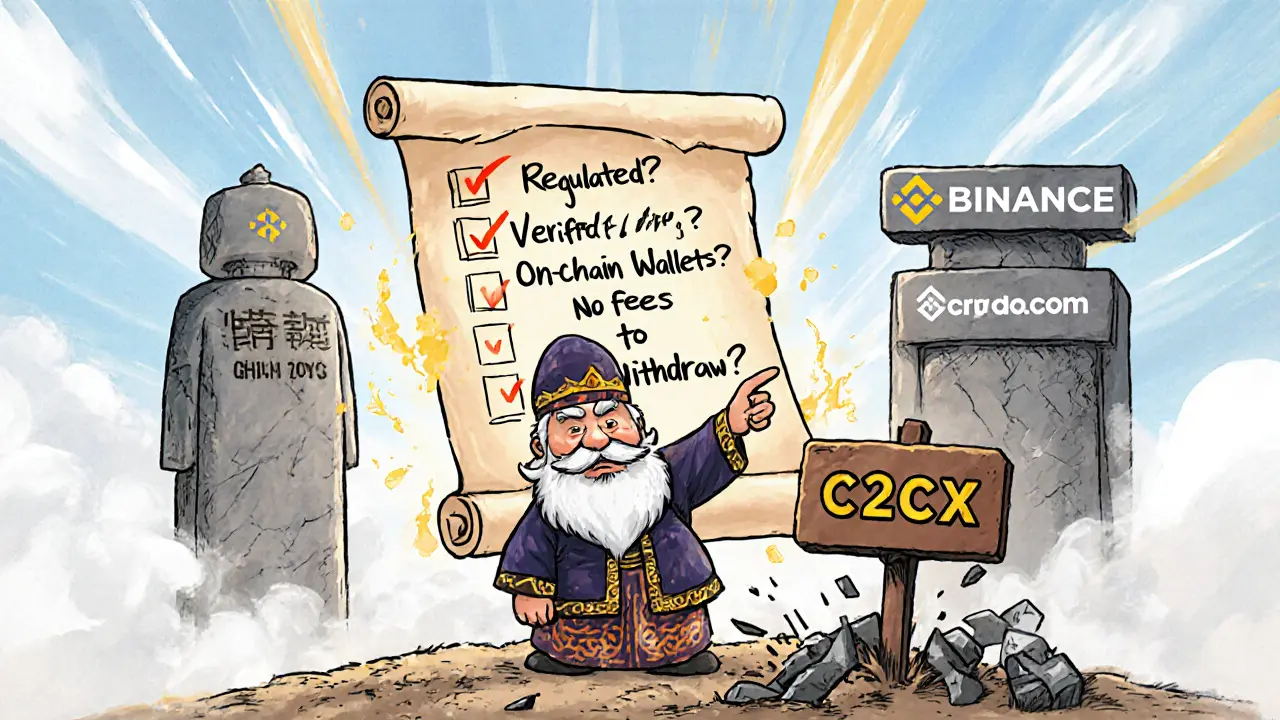
If you’re unsure about a crypto exchange, ask these five questions:
- Is it registered with a financial regulator? Check FinCEN (U.S.), FCA (UK), ASIC (Australia), or MAS (Singapore). Search the regulator’s official database.
- Can you find independent reviews? Look on Reddit, Trustpilot, or CryptoCompare. If every review is glowing and posted in the last 30 days, it’s likely fake.
- Does it have a public team? Real exchanges list founders, CTOs, and compliance officers with LinkedIn profiles. C2CX? No names. No photos. No history.
- Can you verify their wallet addresses? Real exchanges publish their hot and cold wallet addresses on-chain. You can track deposits and withdrawals on blockchain explorers like Etherscan or Blockchain.com.
- Do they ask for money to withdraw? If yes, walk away. Real exchanges never charge fees to release your own crypto.
What to Do If You Already Sent Money to C2CX
If you deposited funds and now can’t access your account:
- Stop sending more money. No matter what they promise, it won’t be returned.
- Report it. File a complaint with the FTC (ReportFraud.ftc.gov) or IC3 (ic3.gov) in the U.S. Provide all screenshots, emails, and transaction IDs.
- Notify your bank or payment provider. If you used a credit card or PayPal, you may be able to dispute the charge. Crypto transactions are irreversible, but the payment gateway might help.
- Don’t fall for recovery scams. Some scammers pose as "crypto recovery experts" who promise to get your money back - for a fee. They’re just the next layer of the same scam.
Safe Alternatives to C2CX
If you want to trade crypto safely, use platforms with proven track records:
- CEX.IO - Best for beginners in the U.S. with fiat on-ramps and strong security.
- Binance - Largest global exchange with C2C trading and low fees.
- Crypto.com - Excellent app experience and regulatory compliance.
- Kraken - Trusted by advanced traders with deep liquidity and transparent fee structure.
All of these platforms have been operating for years. They’ve survived market crashes, hacks, and regulatory crackdowns. They’re not perfect - but they’re real.
Don’t chase promises of quick profits from names you can’t verify. The crypto space is risky enough without adding fake exchanges to the mix.
Frequently Asked Questions
Is C2CX a real crypto exchange?
No, C2CX is not a real crypto exchange. There is no verifiable record of its existence in regulatory databases, blockchain directories, or user communities. It appears to be a scam platform designed to mimic legitimate exchanges like CEX.IO or Binance C2C.
Why can’t I find C2CX on CoinMarketCap or CoinGecko?
Because C2CX doesn’t exist as a functioning exchange. CoinMarketCap and CoinGecko only list platforms that meet minimum criteria: active trading volume, public API, verified team, and regulatory compliance. C2CX meets none of these.
Can I trust C2CX if it has a professional-looking website?
No. Scammers spend money to make fake sites look real. They use professional templates, fake testimonials, and even cloned logos. Always check for regulatory licenses, public team profiles, and on-chain wallet verification - not how polished the site looks.
What should I do if I already sent crypto to C2CX?
Stop all communication. Report the scam to the FTC or IC3. Notify your payment provider if you used a credit card or PayPal. Do not pay any "recovery fees" - those are scams too. Unfortunately, once crypto is sent to a scam site, it’s almost always unrecoverable.
Are there any legal C2CX exchanges in other countries?
No. There are no known legal or registered exchanges using the name C2CX in any country. Any claim that C2CX is regulated in the UK, UAE, or elsewhere is false. Always verify licensing through official government or financial authority websites.
Ankit Varshney
December 1, 2025 AT 19:57Just saw this and had to comment. I lost $1,200 to something called 'C2CX' last year. Thought it was a new Binance feature. Website looked legit, even had fake customer service chat. Never got a single cent back. Don't trust anything that doesn't show regulatory info.
Ann Ellsworth
December 3, 2025 AT 16:54It's not just C2CX-it's the entire ecosystem of crypto-adjacent fraudsters exploiting the cognitive dissonance between retail investors' FOMO and their lack of due diligence. The absence of on-chain verification, regulatory licensing, and transparent KYC infrastructure is not an oversight-it's a structural inevitability of unregulated market entry points. This isn't a scam; it's a systemic failure of market signaling.
Melinda Kiss
December 5, 2025 AT 00:21Thank you for writing this. I've been trying to warn people in my crypto group for months. One girl sent $3,000 to C2CX last week and still thinks she'll get it back if she 'just waits.' I sent her this whole post. She didn't reply. It breaks my heart. Please keep sharing truths like this.
Christy Whitaker
December 5, 2025 AT 16:46People who fall for this deserve to lose everything. You didn't check a single thing. You didn't even Google 'C2CX scam.' You just saw a shiny website and got greedy. Now you're crying about it. Classic.
Nancy Sunshine
December 7, 2025 AT 03:14This is exactly why financial literacy needs to be mandatory in high schools. The fact that someone would deposit crypto into a platform with no verifiable history, no regulatory oversight, and no public team is not just naive-it's a red flag for broader economic vulnerability. We need systemic education, not just reactive warnings. The next generation shouldn't have to learn this the hard way.
Alan Brandon Rivera León
December 8, 2025 AT 21:17Been in crypto since 2017. Seen it all. The names change, but the pattern never does. Fake site → fake testimonials → fake support → disappear. I’ve even seen people get scammed by fake Reddit mods promoting these things. If it sounds too good to be true, it’s not just a red flag-it’s a whole damn fireworks show.
Nora Colombie
December 10, 2025 AT 04:12Why are Americans so gullible? In India, we know not to trust random websites with crypto. We check licenses. We check reviews. We ask before we send. You people think a pretty logo means it's real? Wake up.
Greer Dauphin
December 10, 2025 AT 15:37lol I saw a TikTok ad for C2CX yesterday. Guy was like 'I turned $200 into $2000 in 3 days!' and had a fake screenshot. I screenshot it and posted it on r/CryptoCurrency with the title 'This is what a scam looks like in 2025.' Got 12k upvotes. Scammers are getting lazy.
Bhoomika Agarwal
December 11, 2025 AT 17:30Ha! C2CX? More like C2C-Scam. I've seen these clones pop up every few months-same playbook. They even copy the font from Binance. One time I found a site with the exact same 'withdrawal pending' animation as Kraken. Took me 20 minutes to realize the URL was 'c2cx-support[.]xyz'. Classic.
Katherine Alva
December 12, 2025 AT 17:32It’s heartbreaking how easily hope gets weaponized. People don’t fall for scams because they’re stupid-they fall for them because they’re tired, scared, or desperate. The real crime isn’t the scammer. It’s a system that lets people feel like they have no safe options. 💔
Mark Stoehr
December 12, 2025 AT 18:21fake fake fake. no license no team no nothing. why are you even here? just go to binance or coinbase and stop wasting time.
Shari Heglin
December 13, 2025 AT 12:50While I agree with the general sentiment regarding the nonexistence of C2CX, I must note that the post exhibits a degree of rhetorical overreach by conflating all unverified platforms with outright fraud. There exists a gray area between unregulated startups and malicious actors that requires nuanced distinction rather than blanket condemnation.
Reggie Herbert
December 13, 2025 AT 17:56Let’s be real-C2CX is just another crypto ghost. But let’s also be real: the real problem is that people think crypto is a get-rich-quick scheme. It’s not. It’s tech. If you don’t understand blockchain, don’t trade. Simple. Stop blaming the scammers. Blame the people who think crypto is a slot machine.
Murray Dejarnette
December 14, 2025 AT 12:04Bro I just got scammed by C2CX last week and I’m still in shock. But guess what? I’m not giving up. I’m going to find a way to get my money back. I found this guy on Telegram who says he can track the funds. He just needs a $500 fee to start. Anyone know if he’s legit?
Sarah Locke
December 15, 2025 AT 21:18When I first started trading, I thought every shiny new platform was a hidden gem. Then I lost $800 to a fake exchange called 'BitZonex'-same exact script. Now I check three things before I touch anything: 1) Is it on CoinMarketCap? 2) Does it have a real team with LinkedIn profiles? 3) Do they ask for money to withdraw? If the answer to #3 is yes, I close the tab. Always. No exceptions. You’re not missing out-you’re avoiding disaster.
Mani Kumar
December 17, 2025 AT 08:45Irrelevant. C2CX is non-existent. The real issue is the proliferation of amateur crypto educators on YouTube pushing unvetted platforms. Regulatory bodies should ban influencers who promote unregistered exchanges. This is not a user error-it’s a media failure.
Tatiana Rodriguez
December 19, 2025 AT 04:54I just want to say how much I appreciate this post. I’ve been following crypto since 2015, and I’ve seen so many versions of this-C2CX, BitHive, CryptoPulse, DexXchange… they all follow the same blueprint. Fake trust, fake urgency, fake support. I even had a friend who sent ETH to one because the site had a ‘24/7 live chat’ with a guy named ‘Alex’ who sounded so helpful. Turns out ‘Alex’ was a bot with pre-written responses. I cried for a week. But I’m glad I’m not alone. This post saved me from falling for the next one. Thank you. Seriously. 🙏