Midnight (NIGHT) Airdrop Details: Glacier Drop Eligibility, Claiming & Vesting
Did you miss the Midnight airdrop? If you were holding crypto in mid-2025 and didn't hear about the "Glacier Drop," you might be wondering if there is still time to claim your tokens. The short answer for the primary distribution window is no-the deadline passed on October 4, 2025. However, the story doesn't end there. The Midnight Network has structured its token distribution into three distinct phases, meaning unclaimed tokens are moving into new channels where participation is still possible.
The NIGHT token is the native utility token of the Midnight Network, a privacy-focused sidechain built on the Cardano blockchain. Unlike typical airdrops that hand out free coins for immediate sale, this launch was designed as a long-term community building exercise. It distributed 24 billion NIGHT tokens-the entire genesis mint-to eligible holders across eight major blockchain ecosystems. Here is everything you need to know about how it worked, who qualified, and what happens next.
Who Qualified for the Glacier Drop?
The initial phase, known as the Glacier Drop, targeted a massive audience. The project team took a snapshot of wallet holdings on June 11, 2025. To be eligible, you needed to hold at least $100 worth of cryptocurrency in the native asset of any supported chain at that specific moment. This dollar-based threshold was crucial because it filtered out dust accounts and bot-created addresses while remaining accessible to genuine retail participants.
Eligibility spanned eight major networks:
- Bitcoin (BTC)
- Ethereum (ETH)
- Ripple (XRP)
- Solana (SOL)
- Avalanche (AVAX)
- BNB Chain (BNB)
- Brave (BAT)
- Cardano (ADA)
If you held assets on multiple chains, you could potentially qualify for allocations from each one. For example, if you had $150 in Bitcoin and $120 in Cardano, you would have been eligible for both the Bitcoin-specific allocation and the Cardano-specific allocation. The system used algorithmic transparency to determine eligibility, excluding any addresses flagged on the OFAC Specially Designated Nationals list to ensure regulatory compliance.
How Was the Allocation Calculated?
The distribution wasn't equal for everyone. The 24 billion NIGHT tokens were split using a weighted structure that favored the Cardano ecosystem while still rewarding cross-chain holders. Here is how the pie was sliced:
| Recipient Group | Allocation Percentage | Token Amount |
|---|---|---|
| Cardano (ADA) Holders | 50% | 12 Billion |
| Bitcoin (BTC) Holders | 20% | 4.8 Billion |
| Other Chains (ETH, XRP, SOL, AVAX, BNB, BAT) | 30% | 7.2 Billion |
For the non-Cardano, non-Bitcoin groups, the share was proportional based on the US-dollar value of their holdings at the time of the snapshot. This meant that a large Ethereum holder would receive more than a small Solana holder, even though they were in the same pool. This approach reflected Midnight's deep integration with Cardano while attempting to build a broad, multi-chain community.
The Claiming Process: What Went Wrong for Many?
Even if you were eligible, claiming the tokens required active participation. The portal opened in July 2025 and closed on October 4, 2025. You couldn't just click a button; you had to prove you controlled your private keys. This is where many people got stuck.
To claim, users had to connect their wallet to the official portal (midnight.gd or midnight.network) and provide two cryptographic proofs:
- Signature Proof: Sign a message to demonstrate custody without moving funds.
- Destination Address: Provide a fresh, unused Cardano wallet address to receive the NIGHT tokens.
This requirement created significant friction. First, it excluded anyone holding crypto on centralized exchanges like Coinbase or Binance, unless the exchange decided to distribute on their behalf-which most did not. Second, it forced users from other ecosystems (like Bitcoin or Ethereum) to set up a Cardano wallet. While wallets like Eternl, Lace, Yoroi, and MetaMask were supported, the learning curve for generating a new, secure Cardano address was steep for beginners. If you didn't complete these steps by October 4, your Glacier Drop allocation was forfeited.
What Happens to Unclaimed Tokens?
Here is the good news: unclaimed NIGHT tokens do not vanish. They roll over into subsequent distribution phases. This cascading mechanism ensures that the entire supply eventually enters circulation through community engagement rather than sitting idle.
Phase 2: The Scavenger Mine
Tokens not claimed during the Glacier Drop are now available in the Scavenger Mine. In this phase, participants solve public-good computational puzzles to earn a share of the remaining allocation. This isn't just a giveaway; it serves a dual purpose. It distributes tokens to engaged community members while simultaneously seeding core network infrastructure through useful computation. Think of it as mining, but focused on solving problems that benefit the network.
Phase 3: Lost-and-Found
Any tokens that survive the Scavenger Mine become the bounty for the final phase, called Lost-and-Found. This acts as a last-chance recovery opportunity after the mainnet launches for users who missed earlier distributions. This three-phase structure is designed to maximize participation and ensure decentralization.
Vesting Schedule: No Immediate Cash-Outs
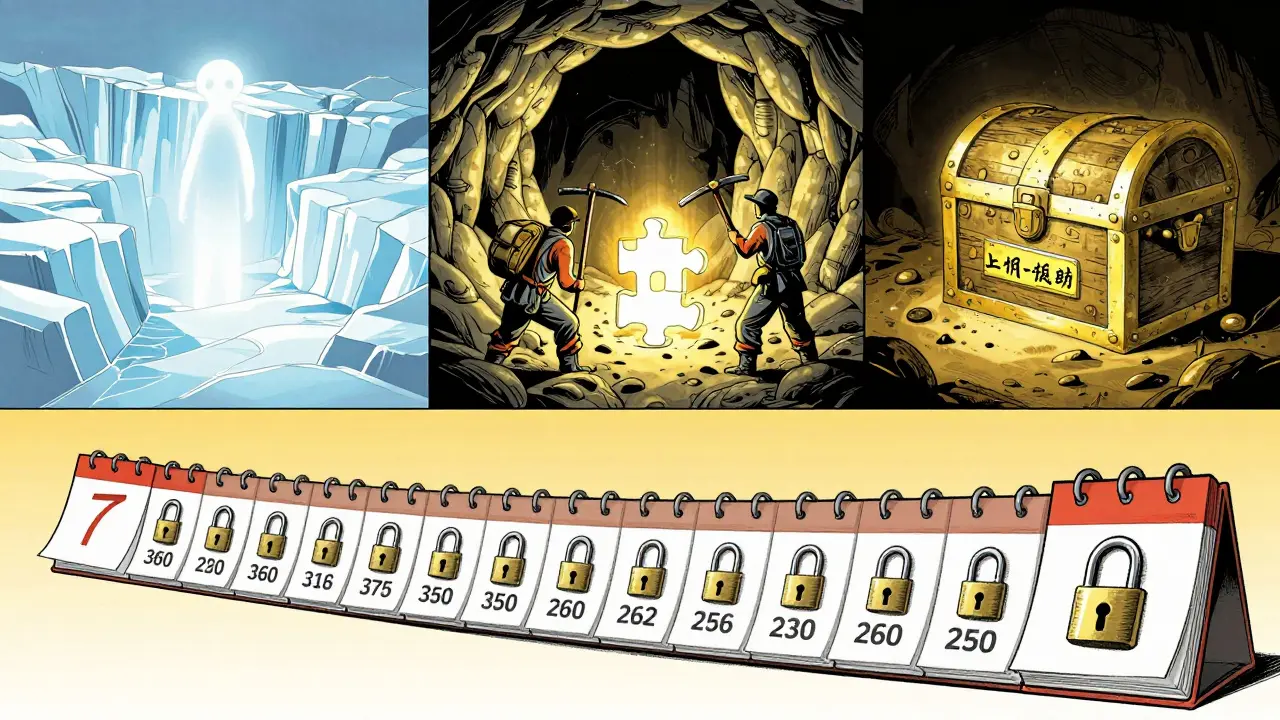
If you successfully claimed your NIGHT tokens, don't expect to sell them all tomorrow. The project implemented a strict vesting schedule to prevent speculative dumping and encourage long-term participation. Claimed tokens are locked via a Cardano smart contract and unlock in four equal phases over 360 days.
- Unlock Frequency: Every 90 days.
- Amount per Unlock: 25% of your total allocation.
- Start Date: The clock starts ticking only after the Midnight mainnet launches, not when you claim.
- Randomization: The exact timing of each quarterly release is randomized within the 360-day window to prevent coordinated selling events.
This "gradual thawing" strategy is unusual for airdrops. Most projects give you immediate liquidity to create hype. Midnight chose stability over speculation, incentivizing holders to participate in block production, governance, and application building using DUST, the network's resource token.
Why Midnight Matters for Privacy
Midnight Network positions itself as bringing "rational privacy" to blockchain technology. Traditional blockchains force a choice between utility and privacy. Bitcoin and Ethereum are transparent, which makes them easy to use but hard to keep private. Monero and Zcash offer strong privacy but can struggle with regulatory compliance and mainstream adoption.
Midnight aims to bridge this gap. It uses advanced cryptographic tools to allow selective disclosure. This means you can prove you have enough funds to make a transaction without revealing your entire balance or identity to the public ledger. This approach allows for regulatory compliance (through OFAC screening and auditability) while protecting user data from prying eyes. For developers, this opens up new possibilities for building applications that require data protection, such as healthcare records or financial auditing tools, without sacrificing the benefits of blockchain technology.
Key Takeaways for Participants
If you are looking to engage with Midnight now, here is your checklist:
- Check Eligibility: If you missed the Glacier Drop, monitor the Scavenger Mine phase for opportunities to earn tokens through computational contributions.
- Set Up a Cardano Wallet: Even if you primarily use Ethereum or Bitcoin, you will need a Cardano-compatible wallet (like Eternl or Lace) to interact with the Midnight ecosystem.
- Understand the Dual-Token Model: NIGHT is for utility and governance. DUST is for paying transaction fees. You will likely need both to fully participate in the network.
- Be Patient: With a 360-day vesting period starting after mainnet launch, this is a long-term play. Do not expect quick profits.
- Stay Secure: Never share your private keys or seed phrases. The official claim process never asks for them. Only sign messages when prompted by the official portal.
The Midnight airdrop represents a shift in how crypto projects distribute tokens. By focusing on self-custody, cross-chain eligibility, and long-term vesting, it attempts to build a resilient, decentralized community rather than a fleeting speculator crowd. Whether you claimed your tokens or are joining via the Scavenger Mine, the emphasis is clear: participation matters more than price.
Is the Midnight NIGHT airdrop still open?
The primary claiming window, known as the Glacier Drop, closed on October 4, 2025. However, unclaimed tokens have moved to Phase 2, the Scavenger Mine, where users can still earn tokens by solving computational puzzles. Future opportunities also exist in Phase 3, the Lost-and-Found.
Do I need a Cardano wallet to claim NIGHT tokens?
Yes. Even if you held Bitcoin or Ethereum during the snapshot, you must provide a valid Cardano wallet address to receive your NIGHT tokens. Supported wallets include Eternl, Lace, Yoroi, and MetaMask (with Cardano extension).
Can I sell my NIGHT tokens immediately after claiming?
No. NIGHT tokens are subject to a 360-day vesting schedule that begins after the Midnight mainnet launches. Tokens unlock in four equal phases of 25% every 90 days. The exact unlock times are randomized to prevent market manipulation.
Why did I get less NIGHT tokens than my friend?
Allocations were weighted. Cardano holders received 50% of the total supply, Bitcoin holders got 20%, and other chains shared the remaining 30%. Additionally, within each group, the amount was proportional to the USD value of your holdings at the June 11, 2025 snapshot.
What is the difference between NIGHT and DUST tokens?
NIGHT is the native utility token used for governance and network participation. DUST is the resource token used to pay for transaction fees and computational costs on the Midnight network. This dual-token model separates economic incentives from operational costs.
Was the snapshot date June 10 or June 11, 2025?
The official snapshot date communicated by the Midnight team was June 11, 2025. While some technical implementations may reference June 10 due to timezone differences or backend processing, eligibility is determined based on the June 11 snapshot criteria.
KEITH WONG
July 3, 2026 AT 21:16lol missed the glacier drop because i was sleeping on my phone 😴💤 typical me. but hey at least there is still the scavenger mine right? or is that just for nerds who like solving puzzles instead of clicking buttons 🤷♂️
Brad Semp
July 4, 2026 AT 18:06The structural integrity of this distribution model is, frankly, an insult to the intelligence of anyone who understands basic economic incentives. To suggest that a 360-day vesting period with randomized unlocks is anything other than a mechanism to artificially suppress liquidity and manipulate market sentiment is delusional. The so-called 'rational privacy' is merely a euphemism for regulatory capture disguised as technological innovation. It is not 'community building'; it is centralized control wrapped in cryptographic obfuscation. One must question why a project claiming decentralization requires such rigid, top-down enforcement of token release schedules. It reeks of traditional finance attempting to wear blockchain clothing.
Hamza k
July 6, 2026 AT 03:25Whoa hold up Brad! 🛑 You are sounding like a total buzzkill here man. Look at the bright side! We have a chance to get free tokens by doing some cool computational stuff. It's like a treasure hunt but for crypto! 🏴☠️✨ Why be so negative when you could be out there mining your fortune? Life is too short to complain about vesting schedules. Embrace the chaos! 🌪️
Brad Semp
July 6, 2026 AT 12:54Your enthusiasm is misplaced, Hamza. You are celebrating a carrot dangled before a mule. The 'computational puzzles' are likely designed to benefit the infrastructure providers, not the retail participants. You are being groomed into a labor force for their network expansion under the guise of gamification. It is a classic bait-and-switch tactic employed by projects that lack genuine organic demand. Do not mistake marketing fluff for substantive value accrual.
Korn Arrieta
July 7, 2026 AT 10:02This entire setup is a disaster waiting to happen. The friction required to claim these tokens is absurd. Forcing users to set up new wallets and sign cryptographic proofs is a barrier that excludes 90% of the target audience. It is not 'security'; it is exclusionary design. The unclaimed tokens rolling over to Phase 2 is just a way to dilute the initial holders while creating a false sense of scarcity. I see through this transparent attempt to hoard value. The vesting schedule is pure manipulation to prevent any real price discovery. It is a scam wrapped in technical jargon.
Curtis Johnson
July 7, 2026 AT 21:31I think we should all try to stay calm and look at the bigger picture here... it's really quite beautiful in its own way. Maybe the friction is intentional to filter out the noise and keep only those who truly believe in the vision. I am trying to be supportive of everyone's perspective, even if they are frustrated. Let us find common ground and maybe help each other navigate the wallet setup process. No need for anger... just understanding.
Korn Arrieta
July 8, 2026 AT 18:18Stop trying to sugarcoat it Curtis. There is no 'beautiful' aspect to losing access to assets because of poor UX design. Your attempts at peacekeeping are irrelevant when the fundamental structure is flawed. People are losing money and time due to incompetence, not 'filtering noise.' It is arrogant to assume everyone has the technical literacy to handle this without guidance. This is not a community; it is a sieve.
Natalie Lucas
July 9, 2026 AT 02:21hey guys dont worry too much about it! i know it sounds complicated but i actually got my wallet set up pretty quick once i watched a tutorial. it feels kinda exciting to be part of something new though right? lets just focus on the positive vibes and see where it goes! 🌈✨
Steven Briggs
July 9, 2026 AT 06:37i read the article carefully. the details about the snapshot date seem clear enough. i suppose if one has the time, the scavenger mine might be worth exploring. otherwise, it seems like a long wait for most people. i will probably just observe from the sidelines for now.
Kim Kay
July 9, 2026 AT 21:02i tried to check my eligibility but the site kept crashing for me. is anyone else having trouble with the portal? i feel like i am missing out but i dont want to make a mistake with my keys. can someone guide me through the safe steps please? i am a bit nervous about doing this wrong.
Jackie D
July 11, 2026 AT 00:42it is fascinating how they split the allocation based on chain dominance. cardano getting half the pie makes sense given the tech stack but it does raise questions about true multi-chain neutrality. i wonder if the scavenger mine will attract different types of participants compared to the initial drop. perhaps we will see more developers and less speculators. the dual token model with dust is also intriguing for fee structures. let us see how the ecosystem evolves.
Kristy Morrow
July 12, 2026 AT 13:40everyone is so obsessed with the tokens. what about the philosophy behind it? privacy is not just a feature it is a human right. yet here we are arguing about vesting schedules like children fighting over candy. the system is broken regardless of whether you get your night tokens or not. wake up sheeple.