What Is Silent Notary (UBSN)? Token Utility, Price Discrepancies & Risks

You’ve probably seen the ticker UBSN is a cryptocurrency token associated with Silent Notary, a blockchain-based platform that provides digital proof of existence for documents and events. It pops up on some tracking sites, sometimes with wild price swings. But what exactly does it do? And more importantly, why does the price look completely different depending on which website you check?
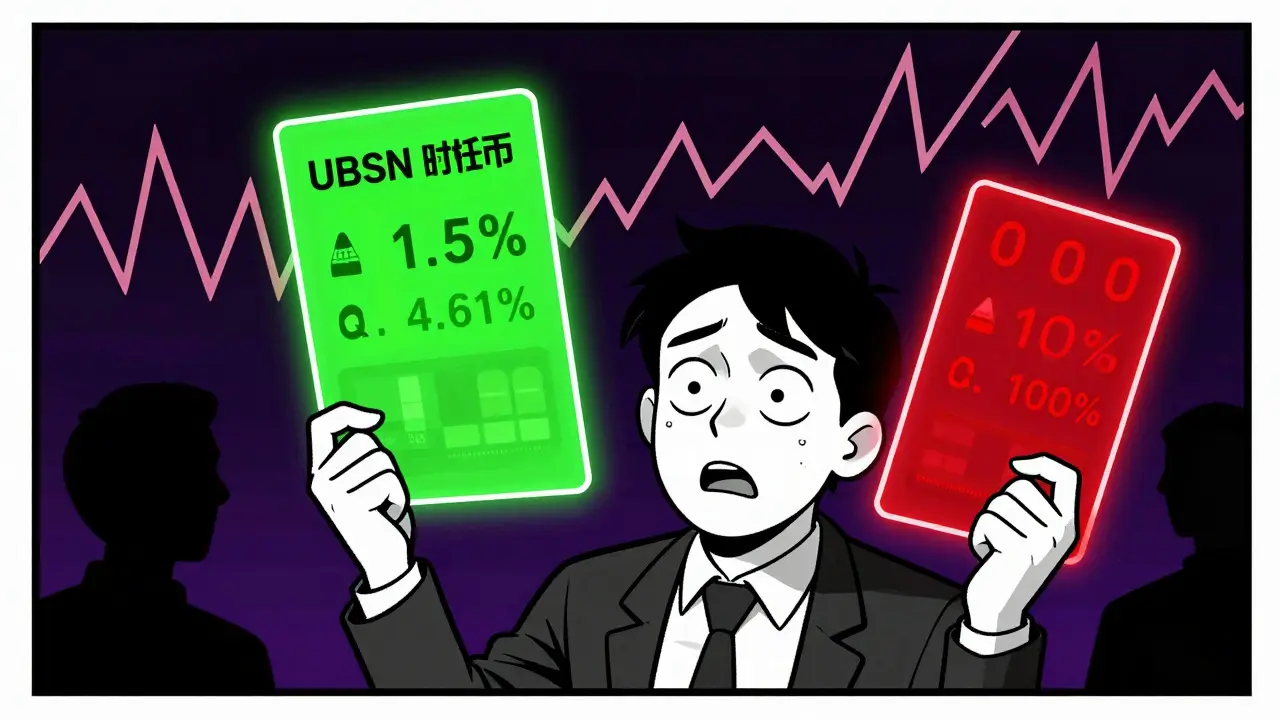
If you are looking at UBSN right now, you might be confused. One site says it’s worth five cents. Another says it’s worth less than a millionth of a cent. This isn’t just a glitch; it’s a sign of how fragmented and risky this specific market segment is. Let’s break down what Silent Notary actually is, how the technology works, and why you need to be extremely careful before putting any money into it.
What Is Silent Notary?
Silent Notary is a service that uses blockchain technology to create an immutable timestamp for digital files, proving they existed in a specific form at a specific time. Think of it like a digital notary stamp. In the old days, you’d go to a physical notary to sign a document so no one could claim later that you forged it or changed the date. Silent Notary tries to automate this using code instead of a person.
The core idea is simple: you upload a file hash (a unique digital fingerprint of your document) to their network. The network records this hash along with the exact time. Because blockchain data cannot be easily altered once written, this record serves as legal-grade proof that the document existed at that moment. If someone tries to change the document later, the hash will no longer match, and the tampering is obvious.
This utility is real. Law firms, intellectual property holders, and supply chain managers use similar tech to prove ownership or authenticity. However, Silent Notary operates on its own private infrastructure rather than relying solely on public blockchains like Ethereum or Bitcoin for storage, which brings us to the next point.
The Technology Behind UBSN: UBIX.Network
Silent Notary runs on top of UBIX.Network is a distributed ledger system based on Directed Acyclic Graph (DAG) technology, designed to handle high-volume transactions without traditional mining. Unlike Bitcoin, which uses blocks chained together, DAG structures allow transactions to reference previous transactions directly. This can theoretically make the network faster and cheaper to use because there are no miners competing for block rewards.
Here is how the process works for a user:
- You take a file (a contract, a photo, a log entry).
- The app generates a cryptographic hash of that file.
- This hash is sent to the UBIX.Network nodes.
- Multiple independent nodes verify and store the hash with a timestamp.
- You receive a certificate of notarization.
The UBSN token is meant to be the fuel for this engine. You would typically pay fees in UBSN to have your documents notarized. In theory, if the service becomes popular, demand for the token goes up. In practice, the adoption has been slow, and the token’s primary function often feels secondary to speculation.
The Price Problem: Why Numbers Don't Match
This is where things get messy. If you search for UBSN today, June 2026, you will see conflicting data. This is not uncommon for low-cap altcoins, but the discrepancies here are extreme.
| Platform | Reported Price | Market Cap Estimate | Data Reliability |
|---|---|---|---|
| CoinGecko | $0.055 - $0.059 | High (due to inflated price) | Questionable (likely stale or wrong pair) |
| CoinStats | $0.000003 - $0.000006 | ~$1 Million | Higher (reflects actual trading volume) |
| CoinCodex | $0.051 | High | Questionable |
Why such a huge difference? Usually, this happens when a token trades on multiple exchanges with very little liquidity. CoinGecko and CoinCodex might be pulling data from an older listing, a different trading pair, or an exchange that hasn’t updated prices in months. CoinStats, showing a price near zero, likely reflects the actual active trading pairs on smaller exchanges like Probit.
If you buy based on the $0.05 price, you might find out too late that the real market value is $0.000005. That is a 10,000% difference. Always check the actual trading volume. If the 24-hour volume is only a few thousand dollars, the price is fragile and can be manipulated by a single large trade.
Tokenomics: Supply and Dilution
When evaluating any crypto coin, you need to look at the supply. For UBSN, the numbers are staggering.
- Max Supply: Approximately 190 billion tokens.
- Circulating Supply: Estimates range from 159 billion to 186 billion.
A supply of 190 billion is massive. Compare this to Bitcoin’s 21 million or even Ethereum’s ~120 million. With such a high supply, each individual token must have a tiny value for the total market cap to remain reasonable. If UBSN were to reach $1 per token, the market cap would be $190 billion-larger than many major tech companies. Given its current obscurity, this is highly unrealistic.
The Fully Diluted Valuation (FDV) helps here. If all 190 billion tokens were in circulation and priced at the lower estimate of $0.000005, the FDV would be around $950,000. This aligns closer with the small market caps reported by reliable trackers. The key takeaway? Do not focus on the price per coin. Focus on the Market Cap. A cheap coin is not necessarily a "good deal" if the market cap is already overvalued relative to its utility.
Risks and Red Flags
I want to be direct here. Investing in UBSN carries significant risk. Here is why:
- Liquidity Risk: Trading mostly happens on small exchanges like Probit. Getting in is easy; getting out with a large amount of money might be impossible without crashing the price.
- Data Integrity: As shown above, basic data like price and market cap is inconsistent across platforms. This suggests poor indexing and potential manipulation.
- Technical Sentiment: Indicators like the RSI (Relative Strength Index) have historically shown "oversold" conditions mixed with bearish trends. There is no strong momentum driving the price up organically.
- Adoption Uncertainty: While the concept of digital notarization is valid, Silent Notary competes with established legal tech solutions and other blockchain projects (like Polygon ID or various IPFS-based storage solutions). It has not captured mainstream attention.
The project also lacks transparency in its development updates. The official channels focus heavily on the service aspect, leaving investors guessing about the roadmap for the token itself. In crypto, if the community doesn’t know what’s coming next, they usually don’t invest.

Is Silent Notary Useful?
Separating the token from the technology, the service itself has merit. Immutable timestamps are useful for:
- Copyright Protection: Artists can prove they created a piece of art before someone else claimed it.
- Legal Evidence: Timestamping emails or contracts to prevent backdating disputes.
- Supply Chain: Recording steps in logistics to ensure authenticity.
However, the usefulness of the service does not automatically translate to the profitability of the UBSN token. Many great technologies fail as investments because the business model doesn’t generate enough demand for the native currency. Users might prefer paying in stablecoins or fiat if the option exists, bypassing the need to buy volatile UBSN tokens.
How to Check Real-Time Data Safely
If you still want to track UBSN, follow these steps to avoid being misled by stale data:
- Ignore Aggregators First: Don’t trust the first number you see on Google. Go directly to CoinGecko, CoinMarketCap, and CoinStats.
- Check the Exchange: Click through to the actual exchange (e.g., Probit). Look at the order book. Are there real buyers and sellers, or just thin lines?
- Verify the Contract Address: On Ethereum-compatible wallets, ensure you are looking at the correct smart contract:
0x86efc496dca70bcfd92d19194290e8457a375773. Scammers often create fake tokens with the same name. - Look at Volume: If the daily volume is under $10,000, treat the price as unreliable. It can be moved by a single whale.
Final Thoughts on UBSN
Silent Notary represents an interesting intersection of law and blockchain. The problem of proving digital existence is real, and the solution is technically sound. However, the UBSN token itself suffers from classic altcoin pitfalls: massive supply, low liquidity, and confusing market data.
For most people, this is not an investment opportunity. It is a speculative asset with high risk. If you are interested in the technology, try the free tier of the notarization service to see if it meets your needs. If you are looking to profit from the token, proceed with extreme caution. Understand that the price you see online might not be the price you can sell at. In crypto, liquidity is king, and UBSN currently lives in a desert.
What is the current price of Silent Notary (UBSN)?
The price varies wildly depending on the source. Some aggregators show prices around $0.05, while others show values below $0.00001. This discrepancy is due to low liquidity and differing data sources. Always check the actual trading volume on exchanges like Probit to find the true market price, which is likely much lower than the higher estimates.
Is Silent Notary a scam?
Silent Notary is not inherently a scam; it provides a legitimate service for digital document notarization using blockchain technology. However, the token (UBSN) is highly speculative and risky. The lack of transparent data and extreme price volatility means investors can lose money easily, even if the underlying service is functional.
Where can I buy UBSN tokens?
UBSN is primarily traded on smaller cryptocurrency exchanges such as Probit. It is generally not available on major centralized exchanges like Binance, Coinbase, or Kraken. This limited availability contributes to its low liquidity and higher risk profile.
What is the maximum supply of UBSN?
The maximum supply of UBSN is capped at approximately 190 billion tokens. With such a large supply, the price per token remains very low. Investors should focus on the total market capitalization rather than the price per coin when evaluating its value.
How does Silent Notary work?
Silent Notary creates a cryptographic hash of a digital file and records this hash on the UBIX.Network blockchain with a timestamp. This creates an immutable proof that the file existed in that specific state at that specific time. It is used for verifying documents, protecting intellectual property, and securing legal evidence.
Why is the UBSN price different on CoinGecko vs CoinStats?
These discrepancies occur because different platforms may pull data from different exchanges or use outdated listings. CoinGecko might be referencing an older pair or a less active market, while CoinStats may reflect the current, albeit low-volume, trading activity. This inconsistency is a red flag for low-liquidity assets.
Is UBSN built on Ethereum?
UBSN has a smart contract address on the Ethereum network (0x86efc496dca70bcfd92d19194290e8457a375773), allowing it to be held in Ethereum-compatible wallets like MetaMask. However, the core notarization service runs on the proprietary UBIX.Network, which uses DAG technology, not the Ethereum mainnet for processing notarizations.