XMS Airdrop Guide: Mars Ecosystem Token Details, Eligibility & Status
Have you heard whispers about the XMS airdrop? If you are looking to claim free tokens from the Mars Ecosystem right now, I have some hard news for you. The major distribution events for the Mars Ecosystem Token (XMS) are over. But before you close this tab, let’s look at why this project matters, what happened during those campaigns, and whether holding XMS makes sense in the current DeFi landscape.
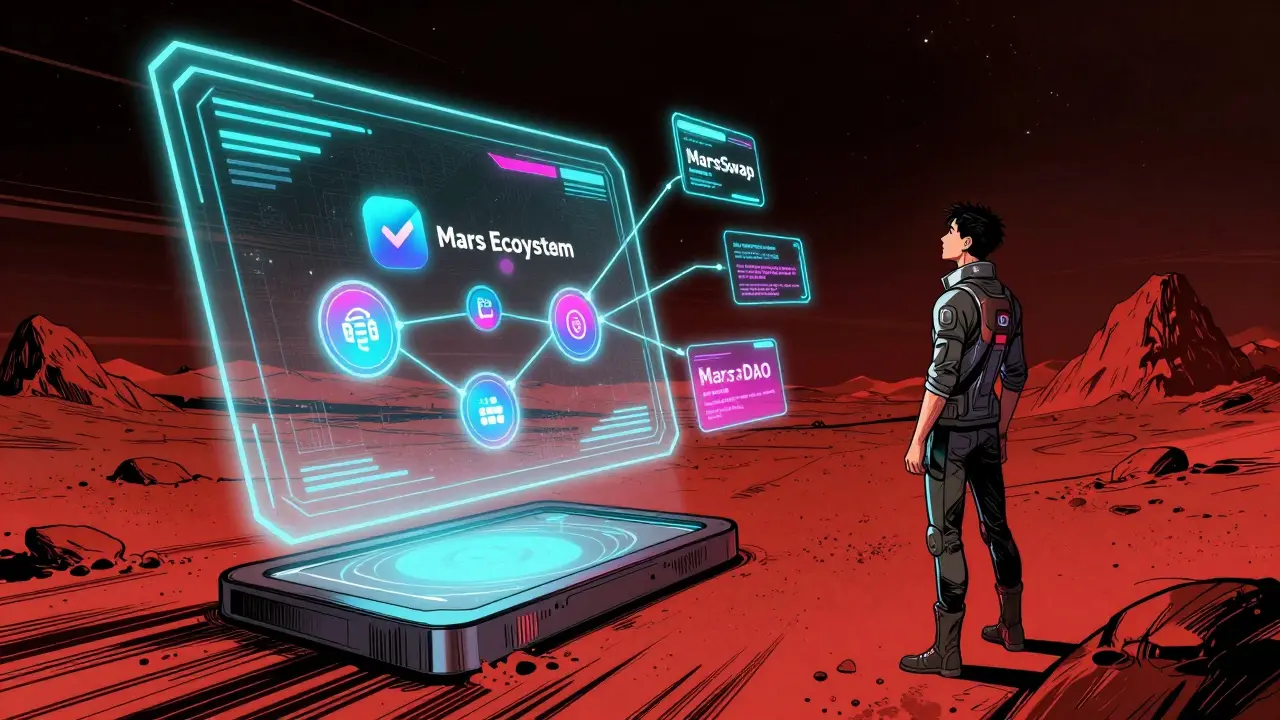
The Mars Ecosystem isn't just another token drop. It is an attempt to build what they call a "New Decentralized Paradigm" for stablecoins. At its core sits the Mars Stablecoin (USDM), supported by the MarsSwap exchange and governed by the MarsDAO. The XMS token is the key that unlocks voting power in this system. Understanding how it works helps you decide if you want to buy into the ecosystem after the free money runs out.
What Is the Mars Ecosystem?
To understand the value of the Mars Ecosystem Token (XMS), we need to look at what it governs. The project positions itself as the "central bank and reserve currency for DeFi." That is a big claim. In practice, it means they are building infrastructure to fix issues they see in existing stablecoin protocols.
Most stablecoin systems suffer from what the team calls "positive externality." In simple terms, the protocol pays the costs to keep the coin stable, but other parties benefit from the transaction volume. Mars Ecosystem tries to solve this by creating a closed loop where users, liquidity providers, and the protocol all share in the efficiency gains.
| Component | Function | Role of XMS |
|---|---|---|
| Mars Stablecoin (USDM) | A decentralized stablecoin pegged to the US Dollar. | Governance decisions affect stability mechanisms. |
| MarsSwap | A decentralized exchange (DEX) for trading assets. | Fees may be used for buybacks or staking rewards. |
| MarsDAO | The decentralized autonomous organization governing the project. | XMS holders vote on proposals and upgrades. |
The technical architecture focuses on four pillars: high stability, capital efficiency, scalability, and decentralization. By operating on the Binance Smart Chain (BSC), the project aims for lower transaction fees compared to Ethereum mainnet, making micro-transactions and frequent swaps more viable for everyday users.
XMS Airdrop History: What Happened?
If you missed the boat, here is exactly what went down. There were two major waves of distribution that defined the early community growth for XMS.
- The Initial Lucky Draw: This was a smaller campaign offering 50 XMS tokens to 1,000 randomly selected participants. It was designed to bootstrap the initial holder base. This event has long since closed.
- The CoinMarketCap Learn & Earn: This was the big one. Mars Ecosystem partnered with CoinMarketCap for a $200,000 prize pool. They targeted 40,000 winners. To qualify, you needed:
- An active CoinMarketCap account.
- A Binance account (since XMS trades there).
- Completion of educational videos about the Mars Ecosystem.
- A perfect score on the final quiz.
- A valid BEP-20 wallet address submitted for distribution.
Both campaigns are now closed. As of June 2026, there are no active public airdrops announced for XMS. Any website claiming you can still sign up for these specific drops is likely a scam. Always verify information through official channels like the Mars Ecosystem website or their verified social media accounts.
Current Market Status of XMS
Now that the free tokens are gone, what is XMS actually worth? The data here is messy, which is common for low-cap tokens. You will see different prices depending on where you look.
Binance lists XMS around $0.000297 USD, while CoinMarketCap shows it closer to $0.0004989 USD. Why the difference? Low liquidity. When trading volume is thin, price discrepancies between exchanges widen because there aren't enough arbitrageurs to smooth them out quickly.
Here is the snapshot of the market reality:
- Market Cap: Approximately $314,755 (Rank #5891 on CoinGecko).
- 24-Hour Volume: Around $2,300 USD. This is critically low. It means buying or selling even a few hundred dollars worth of XMS could move the price significantly.
- Performance: Despite the low volume, historical data shows some resilience. Over the last 90 days, the token saw gains of roughly 16.73%, suggesting periodic interest despite the lack of constant trading activity.
This volatility is a double-edged sword. For small holders, it might mean quick percentage gains. For larger investors, the risk of slippage-where your order pushes the price against you-is very high.
Security and Partnerships
Is the project safe? Security is paramount in DeFi, especially when dealing with stablecoins. Mars Ecosystem addresses this through a bug bounty program hosted on Immunefi. They offer rewards up to $10,000 for finding vulnerabilities. The scope covers serious threats like malicious wallet interactions, contract address substitution, and subdomain takeovers.
On the utility side, Mars Ecosystem has partnered with MugglePay, a C2B (Consumer-to-Business) payment provider. This partnership allows merchants to accept USDM stablecoins via MarsSwap. This is crucial because it moves the project beyond speculation. If people can actually buy coffee or pay bills with USDM, the demand for the underlying infrastructure-and potentially the governance token XMS-becomes more grounded in real-world usage.

How to Buy XMS Now
Since the airdrops are finished, your only option is to purchase XMS on the open market. Here is how to do it safely:
- Create a Wallet: Since XMS operates on the Binance Smart Chain (BEP-20), you need a wallet that supports BSC. MetaMask is the standard choice. Make sure you switch the network to "BNB Smart Chain" in your settings.
- Acquire BNB: You will need BNB (Binance Coin) to swap for XMS and to pay for gas fees on the network. Buy BNB on a centralized exchange like Binance or Coinbase.
- Transfer to Wallet: Send your BNB to your MetaMask address. Double-check the network; sending ERC-20 BNB to a BEP-20 address will result in lost funds.
- Swap on PancakeSwap: Connect your wallet to PancakeSwap (the leading DEX on BSC). Search for the XMS token contract address. Warning: Always copy the contract address from the official Mars Ecosystem website or CoinMarketCap. Scammers create fake tokens with the same name.
- Execute Trade: Swap your BNB for XMS. Set your slippage tolerance appropriately (usually 1-2% for low-volatility periods, but check current conditions).
Risks and Considerations
Before you invest, keep these factors in mind. The crypto space is unforgiving of complacency.
- Liquidity Risk: With daily volumes under $3,000, exiting a large position could be difficult without crashing the price.
- Adoption Uncertainty: While the vision is strong, actual adoption of USDM by merchants is still in early stages. The partnership with MugglePay is a start, but widespread use takes time.
- Regulatory Changes: Stablecoin regulations are evolving globally in 2026. Projects that operate in gray areas may face scrutiny.
- Smart Contract Risk: Even with audits and bounties, bugs can exist. Never invest more than you can afford to lose.
The Mars Ecosystem aims to solve real problems in DeFi, but solving them requires time, trust, and user adoption. The XMS token is the vehicle for governance, not just a speculative asset. Its long-term value depends entirely on the success of USDM and MarsSwap.
Is the XMS airdrop still active in 2026?
No. Both the initial lucky draw and the major CoinMarketCap Learn & Earn campaign have concluded. All tokens from these events have been distributed. There are currently no active public airdrops for XMS.
Which blockchain does XMS run on?
XMS operates on the Binance Smart Chain (BSC), using the BEP-20 token standard. This means you need a BSC-compatible wallet like MetaMask or Trust Wallet to hold and trade it.
Why is the XMS price different on Binance and CoinMarketCap?
The discrepancy is due to low liquidity and trading volume. With limited orders on the books, prices can diverge between exchanges until arbitrage traders align them. This is common for lower-ranked cryptocurrencies.
What is the purpose of the XMS token?
XMS is the governance token for the MarsDAO. Holders use it to vote on proposals related to the Mars Ecosystem, including updates to the USDM stablecoin and MarsSwap protocols.
Can I use XMS to pay for goods?
Not directly. XMS is primarily for governance. However, the ecosystem's stablecoin, USDM, is being integrated into payment systems like MugglePay for merchant transactions. You would typically swap XMS for USDM or other assets to spend.
Is Mars Ecosystem secure?
The project employs security best practices, including a bug bounty program on Immunefi with rewards up to $10,000. However, no smart contract is 100% immune to risks. Always do your own research and never connect your primary wallet to unverified dApps.
Carol @minaszilda
July 2, 2026 AT 05:57It is so important to understand the mechanics behind these ecosystems before diving in. Many people just chase the free tokens without looking at the long-term viability. The Mars project seems to have a solid foundation with USDM and MarsSwap, but governance is key. We need to see if the community actually engages with the DAO proposals or if it remains dormant. Education is the best tool we have in this space. Let us support projects that prioritize stability over hype.
John Curry
July 3, 2026 AT 10:15The irony of a 'decentralized' stablecoin ecosystem relying on such low liquidity is not lost on me. It feels like watching a grand theater performance with an empty audience. The price discrepancy between Binance and CoinMarketCap is a stark reminder of how fragile these micro-markets are. One large sell order could send the price plummeting into the abyss. It is a beautiful concept, certainly, but the reality is quite barren right now.
Routh Middaugh
July 3, 2026 AT 10:20I really appreciate the detailed breakdown here!; especially the part about the MugglePay partnership.;; It shows that they are trying to move beyond just speculation.;; However, I am still skeptical about the adoption rate.;; Can you imagine buying coffee with USDM?;; It sounds futuristic but practically difficult for most merchants.;; Let us hope the integration smooths out over time.;;
Carl Belgrave
July 4, 2026 AT 05:45This is typical crypto garbage designed to fleece the unwary. You think a bug bounty program protects you from a rug pull? Please. These offshore teams disappear faster than you can blink. I say we stick to real assets, not these digital IOUs backed by nothing but promises and code. Do not let them fool you with their 'New Decentralized Paradigm' nonsense. It is all a scam.
Carl Hanzel
July 5, 2026 AT 00:15You are all missing the point entirely. The value is not in the token itself but in the control it gives you over the narrative. Most of you are sheep following the herd. I bought in early because I saw the potential for manipulation. Now I wait while others panic. The low volume is a feature, not a bug. It allows those who know what they are doing to accumulate quietly. Keep dreaming of your $5 airdrop while I build wealth.
Daniel J. Cox
July 6, 2026 AT 15:34Hey everyone! :) I found this guide super helpful. I was worried I missed the boat completely. It is cool to see how BSC is being used for more than just memes. The gas fees are definitely lower which makes small transactions viable. I might try swapping a little bit of BNB for XMS just to see how the interface works. Good luck to all of you out there! :)
Emma Rémond
July 8, 2026 AT 00:38The semantic coherence of this post is laughable. To suggest that a market cap of three hundred thousand dollars represents any form of institutional-grade infrastructure is delusional. The arbitrage inefficiencies cited are merely symptoms of profound illiquidity and lack of sophisticated market participants. One must question the epistemological validity of trusting a DAO governed by retail investors with no economic expertise. It is a house of cards waiting for a breeze.
ELNORA JEFFERSON
July 8, 2026 AT 06:19Boring. Another stablecoin wrapper. Nothing new here. Just another way for developers to cash out while regular users hold the bag. I have seen this movie before and I know how it ends. Save your money and buy gold or something real.
Trent Erman1
July 9, 2026 AT 16:26Great info! 🚀 I think the key here is patience. DeFi evolves slowly. The fact that they have a working DEX and a stablecoin pegged to USD is huge progress. I am staking my XMS in the hope that the buyback mechanism kicks in later this year. Stay positive and keep learning! 💪📈
Fiona Ellis
July 10, 2026 AT 08:20I must admit, the security measures seem adequate on paper. 😊 However, I wonder if the team has considered the psychological impact of such high slippage on new users. It creates a barrier to entry that is frankly discouraging. Perhaps they should implement limit orders on PancakeSwap interfaces specifically for XMS to protect smaller traders. Just a thought! ✨
Nicole Woessner
July 11, 2026 AT 10:55i think the mugglepay partnership is the real game changer here. finally seeing some actual utility outside of trading. its nice when projects focus on real world use cases instead of just pumping the chart. i will keep an eye on this one
Jon Milton
July 12, 2026 AT 07:46Listen up. The tech is sound but the marketing is weak. That is why the volume is low. They need to push harder on the merchant adoption side. If you want to get involved, do it now before the big players notice. But be smart about it. Use a hardware wallet. Do not leave your funds on the exchange. This is the wild west and you need to protect yourself.